The better your copywriting brief is, the better the content you receive will be – it’s the most fundamental rule to outsourcing writing.
Whether you’re commissioning an article, eBook, report, advertisement, profile, brochure or anything else, getting the brief right for your copywriter always makes the process easier and the results better. Plus, if you get the brief right, you’ll spend less time revising or editing.
Here are the 10 questions you always need to answer to build an effective copywriting brief.
1. Who’s your target audience?
The first question we ask all clients is: “Who’s your target audience?” In other words, who are you hoping will read this? Or who do you want to reach?
Once you’ve defined who should be reading your writing, you should also turn your mind to what they’re interested in, what they know, or – most importantly of all – what decision your content is meant to influence?
Defining an audience is the single most important factor in producing good writing of any kind. That’s because it dictates the tone, style and voice the writer uses, as well as what information they include.
2. What’s the key message?
Most people don’t read every word. In fact, one study from Chartbeat and Slate Magazine found most people read only 60% of an article online and just 25% made it 80% of the way through. As many as 38% dropped off straight away.
Memory can be worse still. A lot of what’s written is forgotten almost as soon as the tab is closed. That’s why it’s vital you know what you want to leave behind in the reader’s head, and that the message is clear to them from the moment they set eyes on the writing.
3. What outcome do you want?
What does this content need to achieve and how does it align with your business or marketing plan? How will you measure success?
Any goals should be realistic and sustainable. Content may go viral, but more often than not it is often a slow burn with consistent efforts yielding results over time.
4. What format works best?
Content can take many forms from a press release to a long-form white paper, a succinct listicle, feature article, profile, Q&A or even a short social post. Which form best suits the material, information, audience and outcome?
It’s important to include a word limit or ideal length – particularly if it’s a printed document, or your writer needs to fit it into a design template. We’re always happy to advise on possible content formats to best attract and cut through to your target audience.
5. How will you get the word out?
Distribution is probably the most critical part of the marketing ecosystem. The best content is always tailored to take into account the style, tone and format of the intended publication channel or outlet. Is this content for your own website or a print publication?
Also, how will it be promoted? Will you email it to an existing mailing list, post it on social media, or pay for targeted advertising? Are there any SEO keywords that need to be included? Do you want this content to appear in AI summaries/search?
We can write the best article or report possible, but without an effective distribution plan that has been considered up front, it’s simply not going to reach your audience.
6. What does your writer need to know?
If there is information that needs to be included in a piece of content, you should provide it up front. It will dictate the style, tone and approach and it is much more complex to try and retrofit it – sometimes it requires starting from scratch if it really impacts the angle and intent of a piece of writing.
Conversely, you should always say if any information or approach is off limits, and specify if there are any sensitivities or legalities around the topic. Is there a unique selling point or a point of difference to a competitor your writer should be aware of?
7. What’s next (i.e. the call to action)?
Any piece of writing, content or copy should contain a clear call to action – what do you want your reader to do once they have read it? Maybe it’s simply to inform, raise awareness or educate, but more often than not it is something more active like subscribing, donating, following or buying.
Putting this call to action at its heart will achieve better results.
8. What’s the deadline?
It sounds obvious, but so many briefs leave out this vital detail: the due date.
Always remember to build in a timeline for revisions and changes, edits and a final proofread. We suggest you provide your writer with both a due date and a publication date – ideally at least a week apart (depending on what the content is).
9. Who’s the author?
Sometimes an article or piece of content comes from a homogenous group or company, but other times it needs a more personal, singular voice.
If the content is being ghostwritten, whose name will go on it as author, and is there anything we need to know about them and their particular style or personality, or their expertise and opinions on the topic? Similarly, are there brand guidelines, tone of voice or style guidelines that need to be adhered to?
10. What else should it link to?
What other content or information does this copy relate to (online or print)? Will it be accompanied by video, images, graphs, charts or data? Does it need to include links to or from any existing website pages or information?
And finally, keep your brief, well, brief…
A brief should be a summary of what you need and can be as simple as a bullet point list. With the exception of background research, it should never be longer than the piece of copy or content that you need written.
We speak from experience. We’ve frequently received briefs that are two, three, four, five or even six times as long as the piece of content we’ve been asked to write.
Cluttering your brief with repetition or extraneous information and detail makes it harder to find the real message or what’s really important.
Download our copywriting brief template
Good writing always begins with a good brief.
Download the practical briefing template we use to help clients commission better articles, reports, website copy and thought leadership content.
We’ll send you the template and occasional insights on content, positioning and AI-era communication strategy. No spam.
Frequently Asked Questions
Do I need a brief for every piece of content?
Yes, but it doesn’t need to be elaborate.
A brief for a short LinkedIn post might be three bullet points. A brief for a long-form white paper might run to a page or more.
The format should scale with the complexity of the job. What shouldn’t change is the discipline: every piece of content benefits from someone thinking clearly about audience, message and outcome before the writing starts.
What if I don’t know the answers to some of these questions?
Then the content probably isn’t ready to be commissioned yet, and that’s useful information.
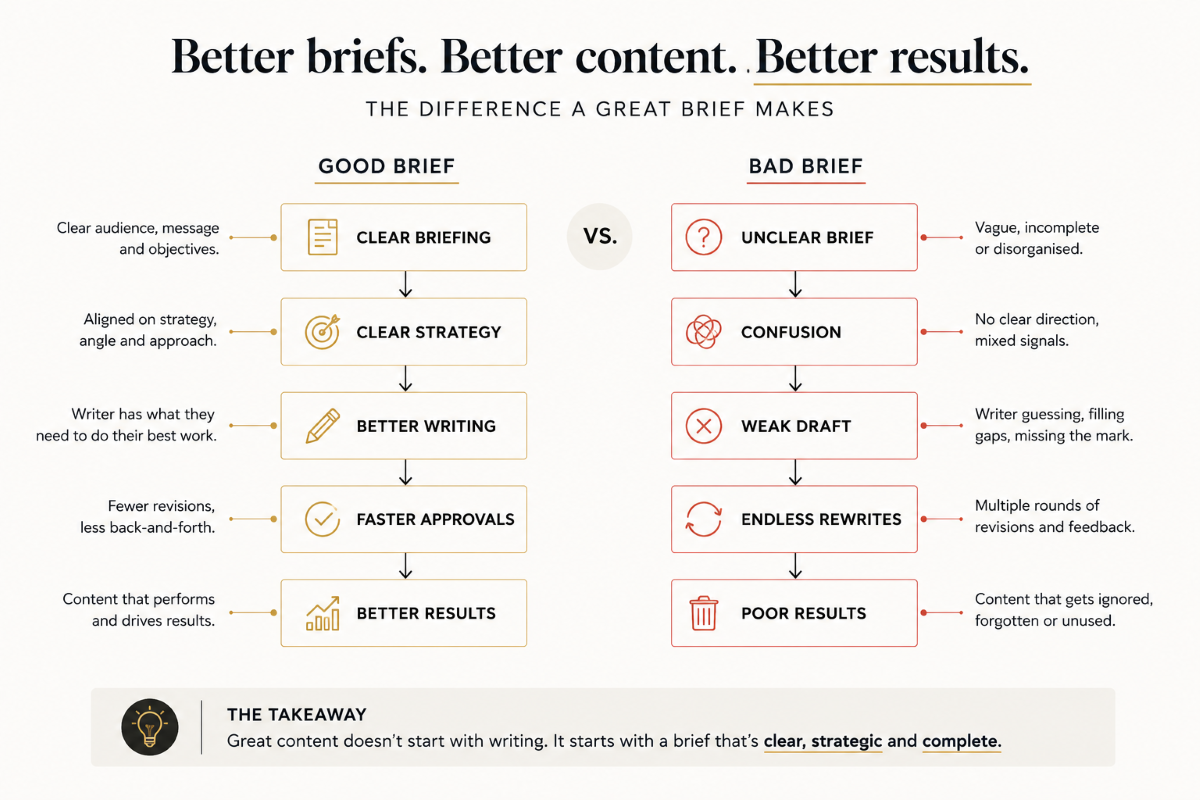
A good brief surfaces strategic gaps early. If you can’t clearly define your audience, key message or desired outcome, the writing process will usually become slower, more expensive and more revision-heavy.
Work out the strategy first. The content will be better for it.
Can I use this for AI writing tools as well as human writers?
Yes, definitely, and it’s just as important.
A vague prompt produces vague AI output for exactly the same reason a vague brief produces a vague draft: the tool can only work with what it’s given.
If anything, AI tools are less forgiving. A human writer may realise something’s missing and ask a clarifying question. An AI will simply fill the gap with something plausible.
A strong brief is your best defence against plausible-but-wrong content.
How long should a brief take to write?
Usually 15 to 30 minutes if the strategy is already clear.
If it’s taking much longer than that, it often means the audience, positioning or desired outcome still hasn’t been fully thought through, which is worth discovering before you start paying for content production.
What should be included in a copywriting brief?
A good copywriting brief should define the audience, key message, business objective, content format, distribution channel, call to action, deadline and any important background information or constraints.
The goal isn’t to control every word. It’s to give the writer enough strategic clarity to produce effective work quickly.
Why do content projects often require so many revisions?
Usually because the brief wasn’t clear enough at the beginning.
When audience, positioning, tone or objectives haven’t been properly defined upfront, stakeholders often react to drafts emotionally or inconsistently, leading to multiple revision rounds and conflicting feedback.
A strong brief reduces ambiguity before the drafting process starts.
