What every law firm website needs to do in the AI age
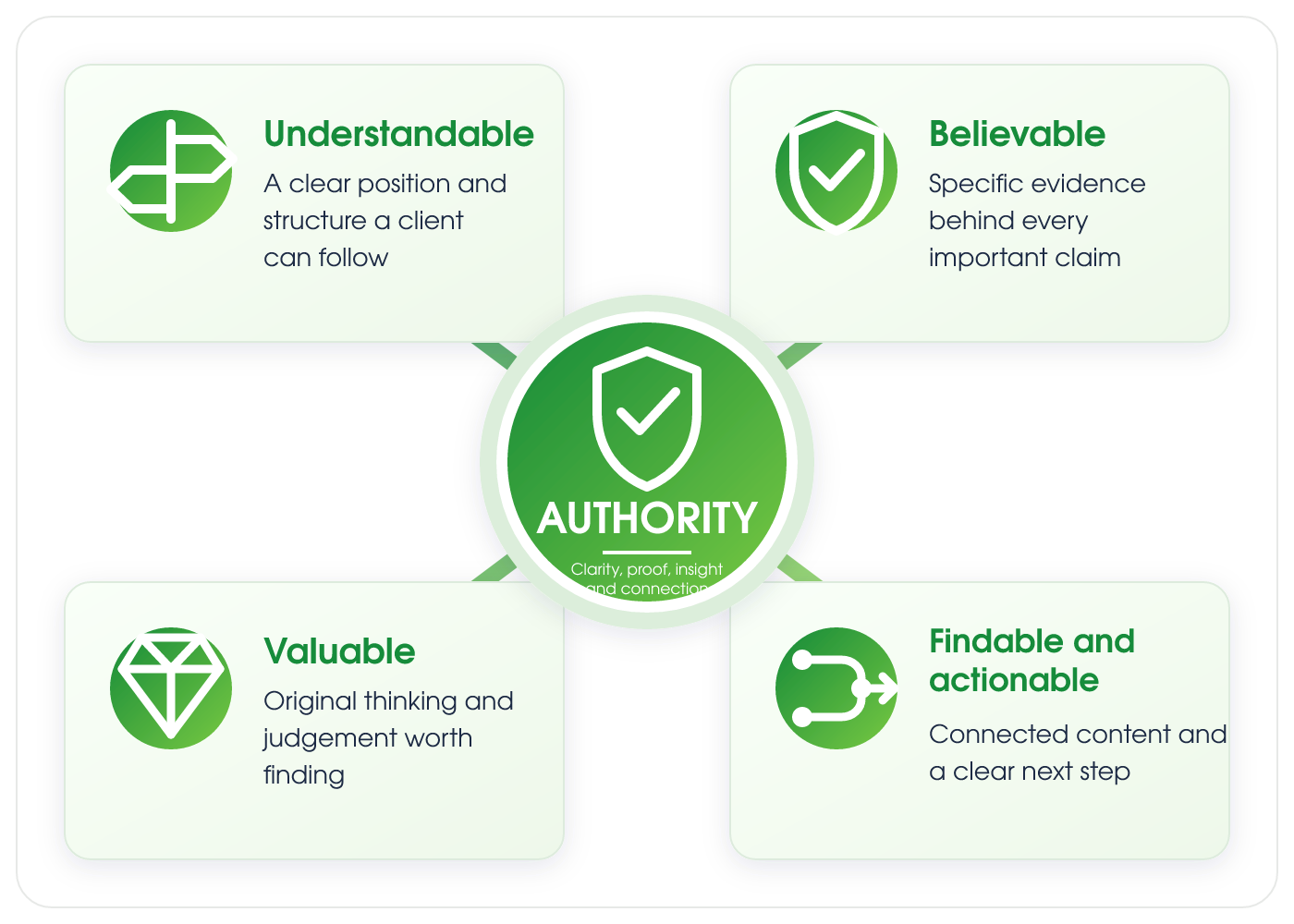
A law firm website in the AI age doesn’t need more words for the sake of it. It needs clearer positioning, stronger evidence, clear thinking (original thinking is better still) and a structure that makes all three easy to find - both by prospective clients and by the systems summarising you and your firm before they arrive. Here's how your firm can do just that.
1. Make the firm understandable
Most law firm websites start and end with slogans. How many times do we really need to read that a firm is "commercial, practical and client-focused"? That's not positioning, it's a laundry list - the same one being written down by every one of your rivals.
A real position says who the firm is for, what problems it solves, and why a client should choose it over another capable firm. In other words, it has to be something a competitor couldn't paste onto their own site unchanged.
Don't just tell everyone "we're different", lead with what you really do. For example:
“We help founder-led businesses manage the legal problems that arise when growth outpaces structure.”
This gives the whole site direction. It allows practice-area pages to be built around client problems rather than capability lists. It lets you build focused sector pages where the knowledge is real. And it provides an information architecture that reflects how clients actually think rather than your firm's internal organisation.
This is positioning and messaging strategy rather than website content in the strictest sense. However, no amount of elegant copy can compensate for a firm that hasn't yet decided who it's for, what it wants to be known for or why a client should choose it over a rival.
Website content can express a position but it shouldn't be used to invent one.
A clear position only earns trust if something backs it up.
2. Make its expertise believable
If the site says the firm is experienced, where's the proof? A law firm website shouldn't merely say trust us, it should make trust the reasonable conclusion.
- Matters, case studies and outcomes, named where possible.
- Lawyer profiles that answer “why this lawyer for this problem,” not just a CV.
- Rankings, credentials and testimonials that are checkable, not just claimed.
- Visible authorship, showing a lawyer's thinking on issues that impact prospective clients in the form of articles and guides (see below).
Clear positioning and strong evidence still need something worth saying
3. Make its thinking valuable
AI can reproduce a competent, generic legal explanation instantly. So there's not usually any value to use your website to simply produce words your clients and other readers can find elsewhere for free.
What AI can't manufacture is the earned judgement that comes from sitting in hours of client meetings, from seeing a judge react to particular arguments or experiencing first-hand the problems that arise from a poorly-drafted clause. In a world flooded with adequate explanation, high-calibre human judgement is becoming a scarce asset. What counts today is distinct viewpoints, useful frameworks, patterns only years of real matters can reveal and distinctions nobody else has noticed.
You can read more about this on our thought leadership page.
None of it matters if nobody can act on it.
4. Make it findable and actionable
Valuable expertise can only build authority if people and machines can find it and people can see what to do next.
That means your thinking shouldn't appear in scattered articles, but as a connected body of expertise that links a strong pillar page (e.g a sector or practice goup page) with supporting guides and insights, relevant lawyer profiles, matters, case studies and other evidence. It should also be crawlable, fast, mobile-friendly and logically organised, with no important expertise trapped in images or PDFs or buried three menus deep.
Once readers find what they need, offer a next step that matches their readiness: read a related article, explore an in-depth guide, view the relevant service or lawyer profile, make an enquiry or book a consultation. Not every visitor is ready to speak immediately, so not every page should end with the same generic demand to “contact us.”
Great thinking nobody can find or act on is wasted thinking.